Cosmic View
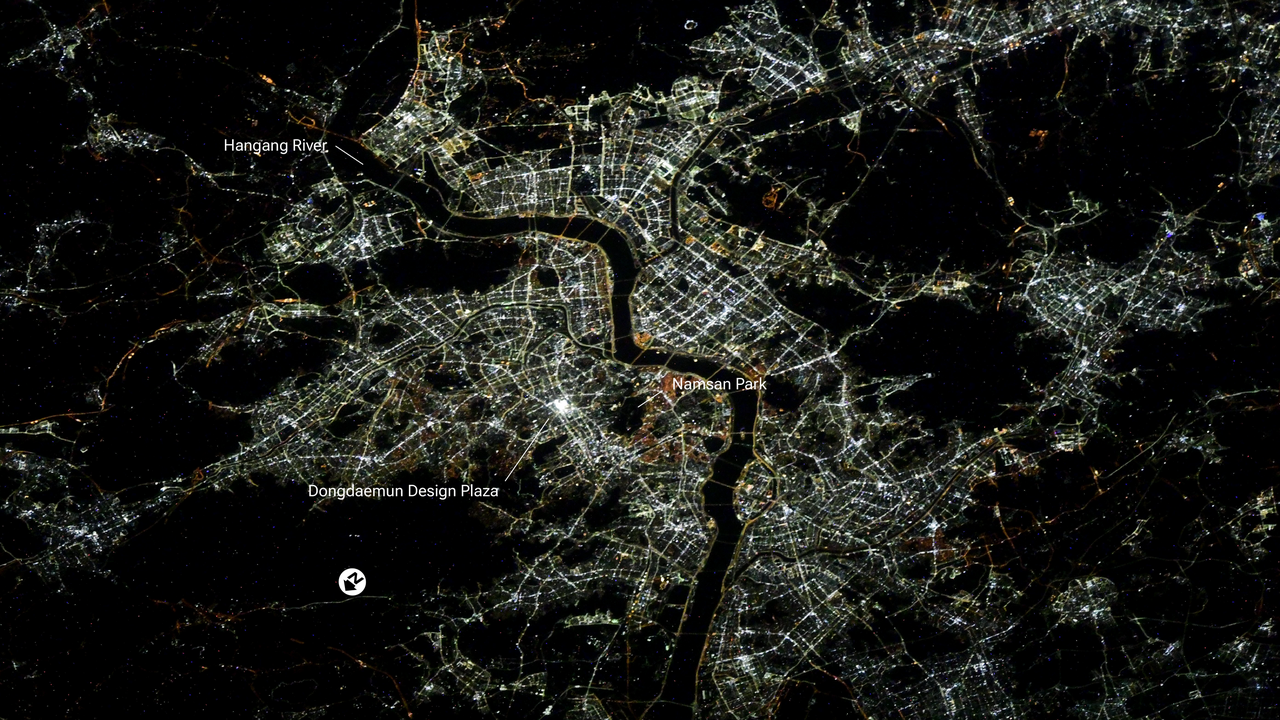
A city is where a life ordinarily feels large.
Seoul · ISS064-E-40609 · 2 March 2021 · NASA
Source
Astronaut photograph from the International Space Station, about 2 a.m. local time. The dark line is the Han River. The frame is a city, so the rail carries the order of magnitude, not a surveyed width of this crop. A global VIIRS Black Marble composite cannot hold a single city at this size. This photograph can.

Earth
12,742 km
Farther from home than anyone had gone, the whole world fit in one frame, above another world’s horizon.
Apollo 8 · AS08-14-2383 · 24 December 1968 · NASA / William Anders
Source
Hasselblad photograph, about 15:40 GMT, near 110 degrees east lunar longitude. Mean diameter of Earth, 12,742 km. Equatorial diameter is 12,756 km. Circumference along the equator, 40,075 km. The number on the frame is the mean.
Earth and Moon
384,400 km
The space between two worlds is part of the picture.
Earth, Moon, and the mean center-to-center distance are shown to the same scale.
Source
Schematic of the separation, not a photograph of the two together. The disks are real spacecraft images, reduced to the true diameter ratio. Earth is Apollo 17, AS17-148-22727, 7 December 1972, NASA. The Moon is Galileo, PIA00405, 7 December 1992, NASA / JPL / USGS. That Moon frame mixes violet and near-infrared filters, so its color is not what the eye would see. NASA Moon Fact Sheet: semimajor axis 384,400 km, about 1.3 light-seconds. Mean perigee 363,300 km, mean apogee 405,500 km, eccentricity 0.0549. Sidereal period 27.32 days. Over a year the distance ranges more widely, about 357,000 km to 407,000 km. Earth and the Moon orbit a barycenter about 4,670 km from Earth’s center, still inside the Earth. Moon diameter about 3,475 km.
Sun
1 AU
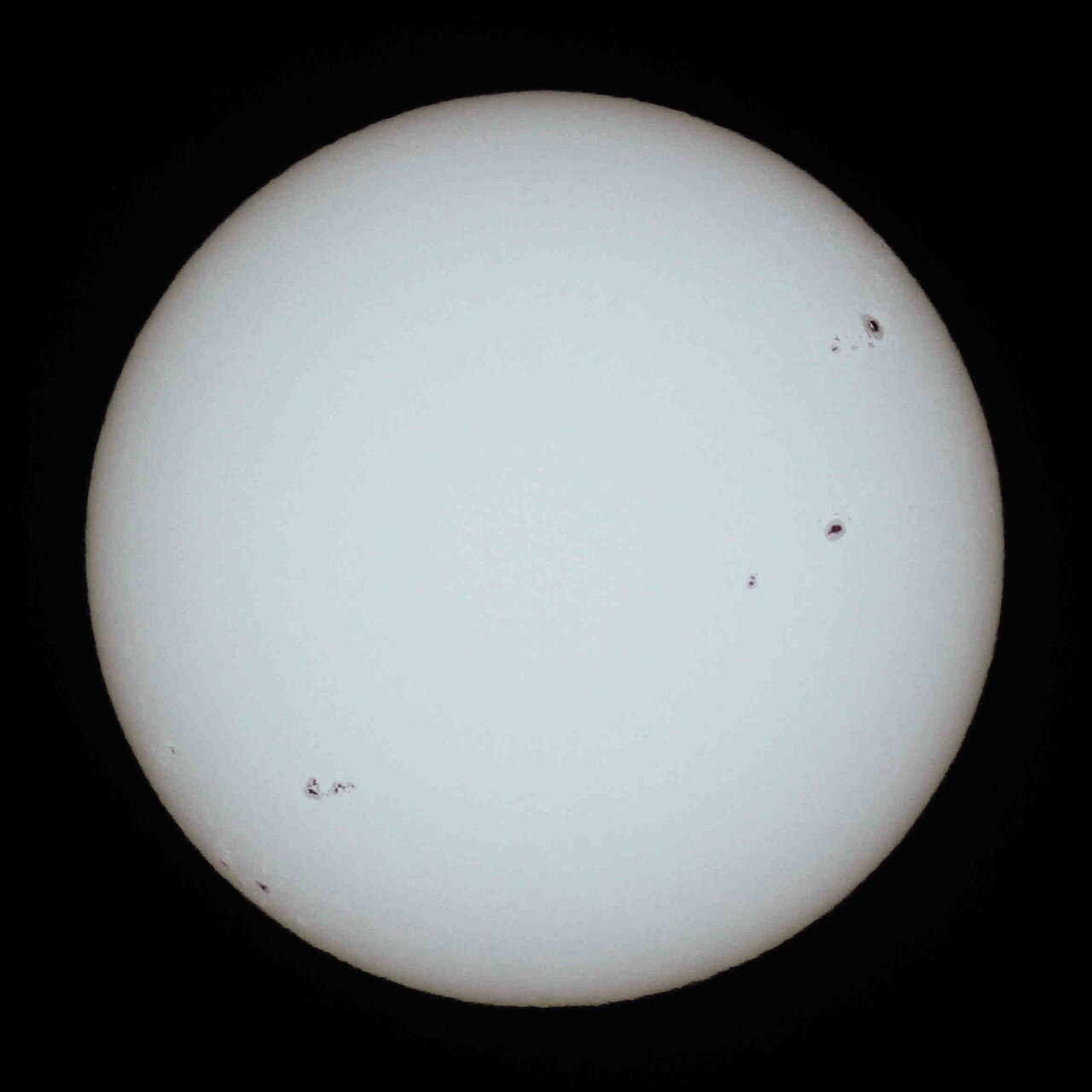
Kilometers stop being a useful ruler. One astronomical unit is the mean distance from Earth to the Sun.
The gap is true. The Earth mark is enlarged enough to find. Geoff Elston, 27 October 2013, CC BY 4.0
Source
One astronomical unit is 149,597,870.7 km, the IAU conventional value. The Sun’s photosphere is about 1.392 million km across, so the unit is a little more than one hundred solar diameters. The photograph is a white-light disk through an 80 mm refractor and a full-aperture solar filter. Society for Popular Astronomy. It is not a spacecraft image.
Pale Blue Dot
~40 AU
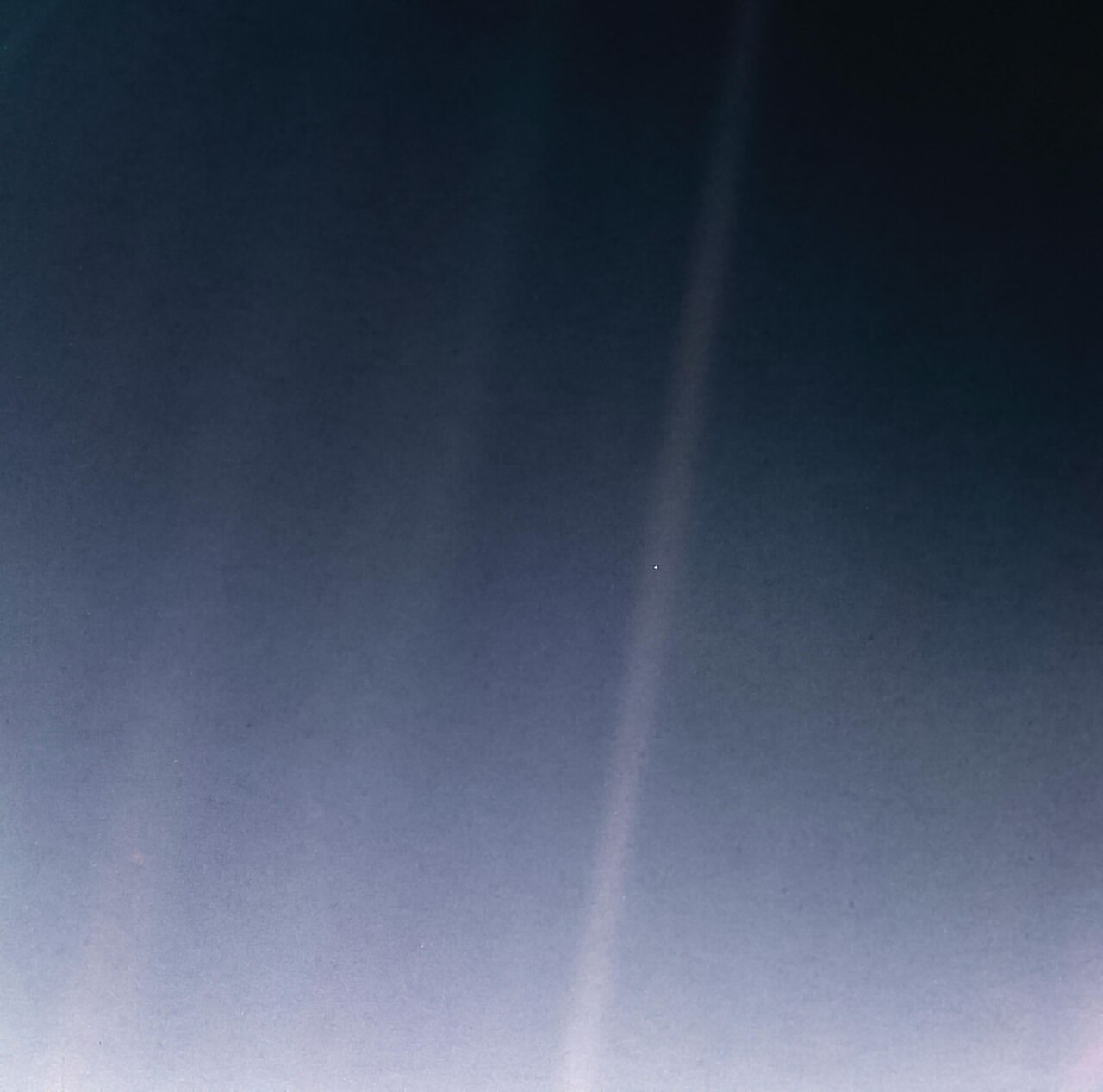
Earthrise held a world. Voyager almost loses it.
On it everyone you love, everyone you know, everyone you ever heard of, every human being who ever was, lived out their lives.
Carl Sagan, Pale Blue Dot, 1994. Voyager 1 · 14 February 1990 · NASA / JPL-Caltech
Source
About 6 billion kilometers from the Sun, roughly 40 AU. Earth is the bright speck in the beam. The file widely circulated now is a 2020 processing of that exposure. In the same book he writes that the speck underscores our responsibility to deal more kindly with one another, and to preserve and cherish the pale blue dot, the only home we’ve ever known. That reflection belongs with the picture. It is not the ending of this walk.
Nearest star
4.25 ly
SunProxima
The nearest star is not nearby. Light is the ruler now.
Too faint for the unaided eye. Not a portrait of a star.
Source
Gaia Data Release 3 parallax 768.0665 milliarcseconds, which is 4.2465 light-years. A light-year is the distance light travels in one year. The frame rounds to 4.25. A survey field of this region shows Alpha Centauri bright and Proxima faint beside it. That brightness would lie. The distance is the plate.
From inside the disk
~100,000 ly
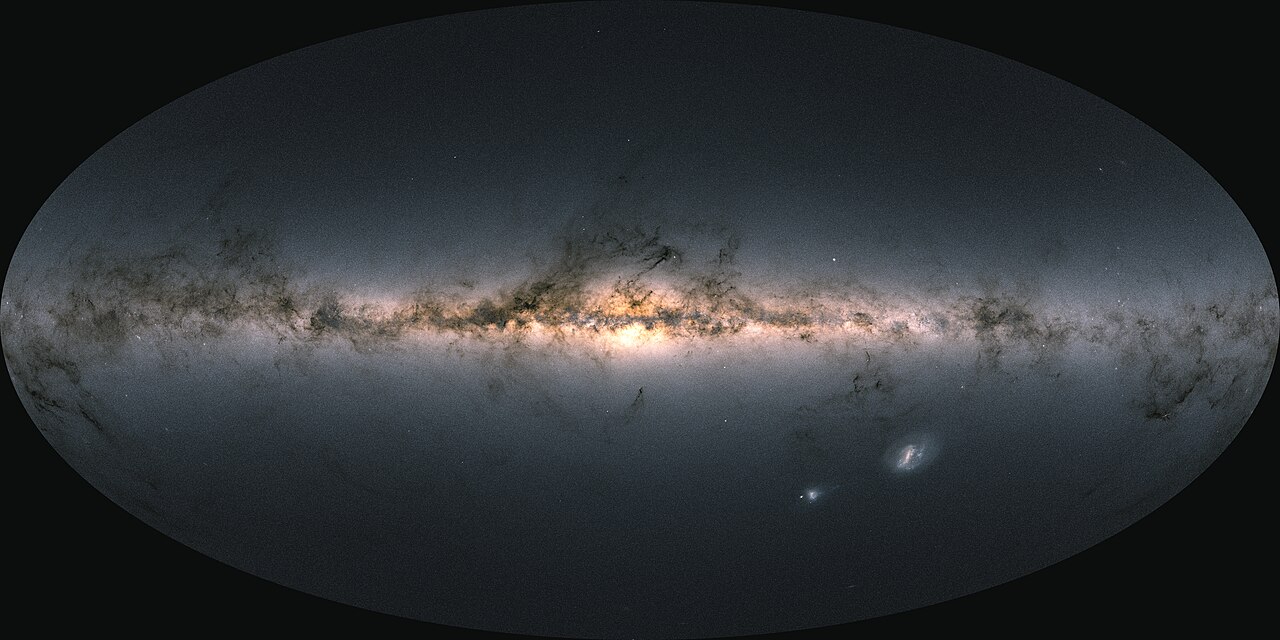
No spacecraft has gone far enough to photograph the Milky Way from outside. This map is built from inside it.
Gaia EDR3 · 3 December 2020 · ESA / Gaia / DPAC
Source
Total brightness and color of more than 1.8 billion stars. Galactic coordinates: the bright band is the disk we are in, not a galaxy seen from outside. An edge-on portrait of another galaxy would be an analog. This is the sky. The stellar disk is about 100,000 light-years across. The halo is larger. Some isophotal estimates sit nearer 87,000. CC BY-SA 3.0 IGO.
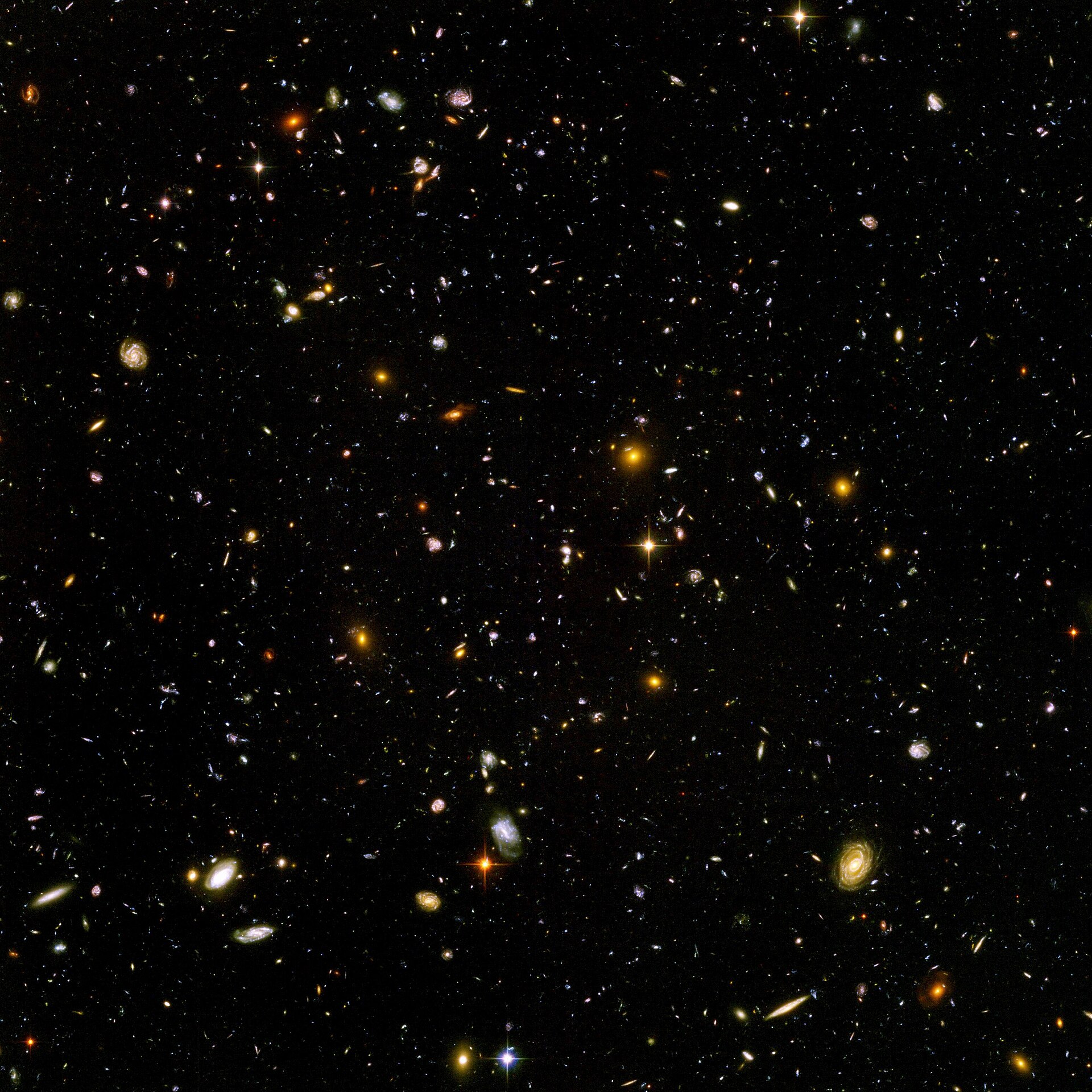
Deep field
Not a wider sky. A very small patch, holding thousands of galaxies.
Hubble Ultra Deep Field · 24 September 2003 to 16 January 2004 · NASA, ESA, S. Beckwith and the HUDF Team
Source
About 10,000 galaxies in a patch of Fornax roughly a tenth the width of the Moon. 800 exposures, 11.3 days of integration, released 9 March 2004. The ground-based view of this patch looks nearly empty.
Last light
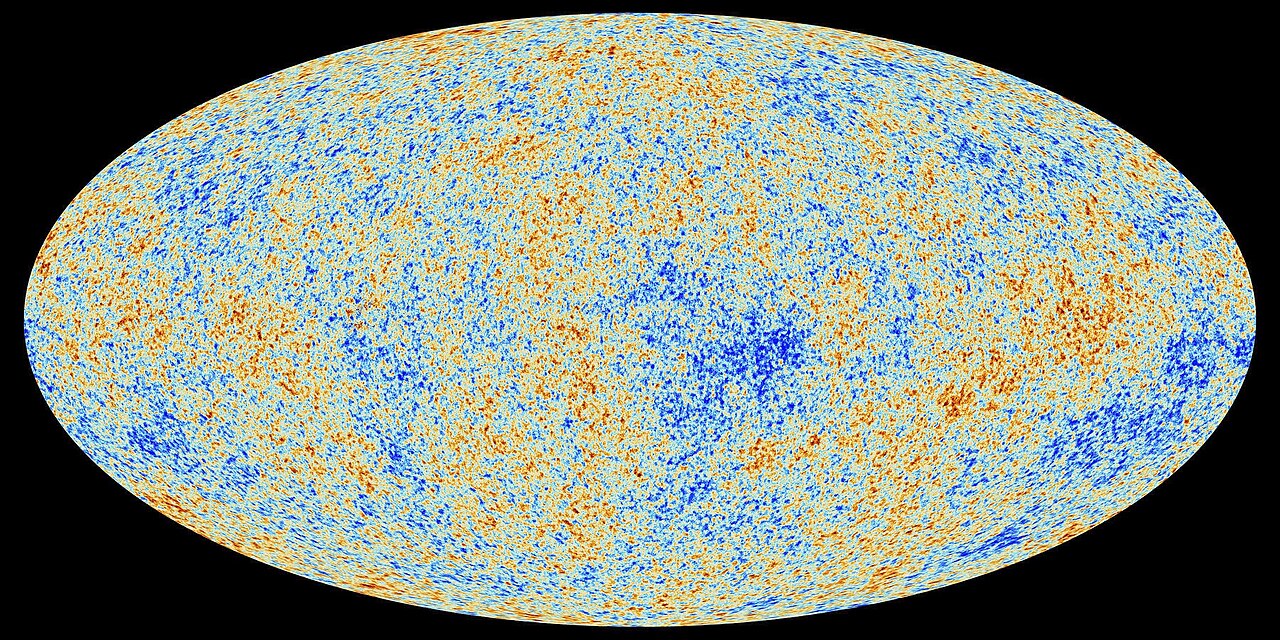
380,000 years
Until now the change was distance. Farther is also earlier. This is the oldest light that could travel freely.
Planck · 2018 legacy release · ESA / Planck Collaboration
Source
Temperature anisotropies of the cosmic microwave background. This is the last-scattering surface, about 380,000 years after the Big Bang, not a photograph of objects. Emission from the Milky Way has been removed. CC BY 4.0. A galaxy survey slice would be a schematic of a later web. It is not this map.
The phrase
While other entrepreneurs struggled to develop a worldview, he
developed
a cosmic view.
Walter Isaacson, Elon Musk, page 12. Kindle edition.
This walk takes that distinction literally. It does not decide what the phrase proves.
Source
With the conviction of a prophet, he would speak about the need to nurture the flame of human consciousness, fathom the universe, and save our planet. At first I thought this was mainly role-playing, the team-boosting pep talks and podcast fantasies of a man-child who had read The Hitchhiker’s Guide to the Galaxy once too often. But the more I encountered it, the more I came to believe that his sense of mission was part of what drove him.
His own words, kept here and not on the frames.
Consciousness should be thought of as a tiny candle in a vast darkness that could easily go out. We should do anything possible to keep that flame alive.
This tiny candle of consciousness we have on Earth might be all there is.
The goal of @SpaceX is expansion of consciousness to the stars so that we may understand what questions to ask about the answer that is the Universe.
The method
Curiosity. Expand the scope and scale of consciousness in order to understand the reality we live in.
The Hitchhiker’s Guide to the Galaxy stays here as his stated origin of the question-problem. It is not the mythology of this site. Works that set love inside a cosmic frame are gathered after the return.
Once they had one
What have people done with a cosmic view, once they had one?
And Love in their midst, their equal in length and breadth.
Observe her with your mind, and do not sit with wondering eyes.Empedocles. Love and Strife, as powers in a cycle.
The Love which moves the sun and the other stars.
l’amor che move il sole e l’altre stelle.
Dante, Paradiso. A cosmos whose last motion is love.
Love is the most universal, the most tremendous
and the most mysterious of the cosmic forces.Teilhard de Chardin. Evolution, consciousness, and love, thought together.
Sources
Dante Alighieri, Paradiso, canto 33, line 145. Henry Wadsworth Longfellow’s translation.
Empedocles, fragment 17. Kathleen Freeman’s translation, Ancilla to the Pre-Socratic Philosophers, 1948.
Pierre Teilhard de Chardin, Human Energy, as printed in On Love and Happiness, 1984. Some editions read “mystical” where this one reads “mysterious.”